
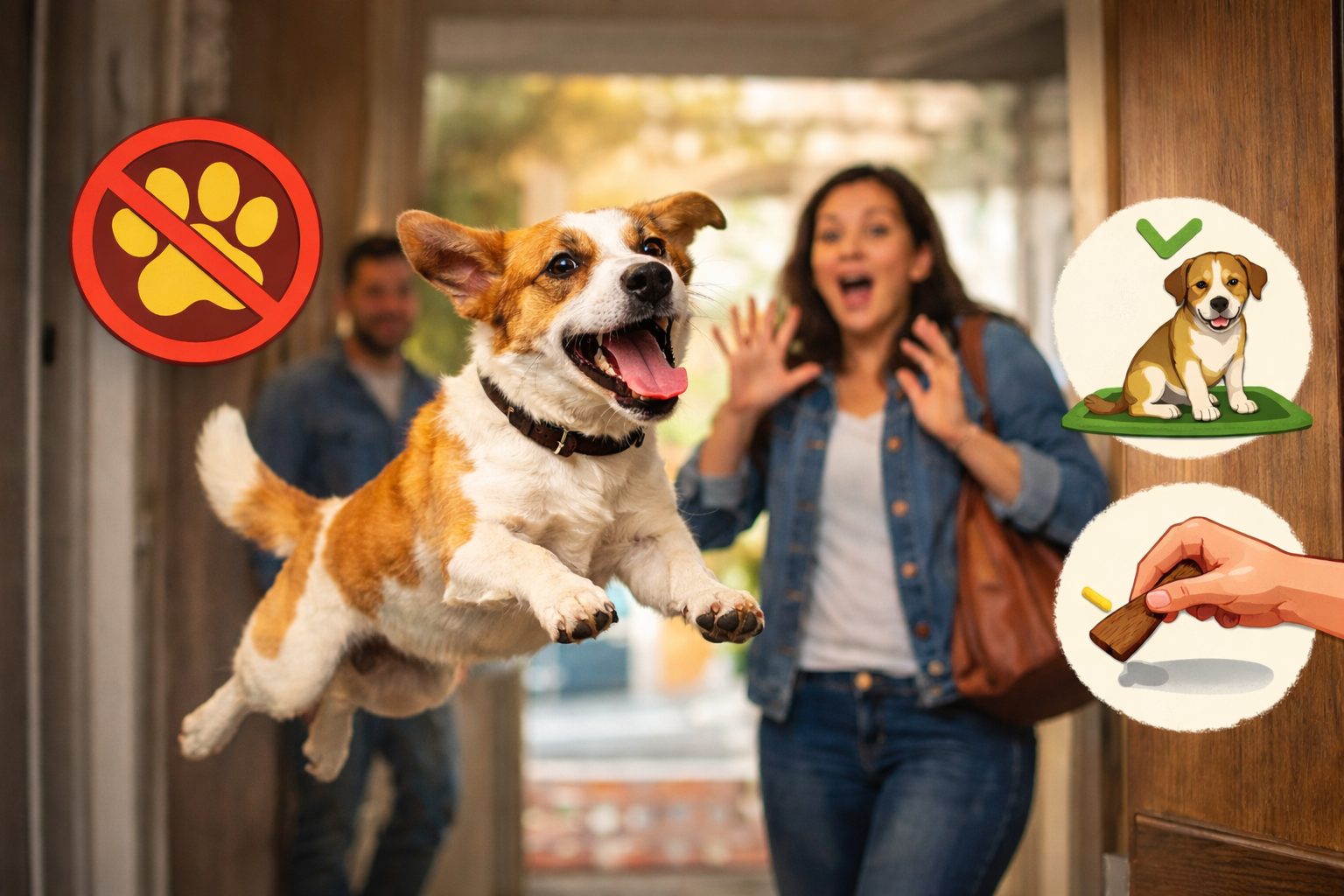
If your dog gets so excited and runs straight at a person like he is a flying missile whenever someone walks through the door, you are not the only one. Jumping is one of the most frequently encountered dog behavior issues that owners have to face, especially in busy homes. At a Singapore dog training school, we see this every single week.
The good news is that jumping is not a “bad dog” problem. It is a communication problem. Dogs jump for clear reasons, and once you understand why it is happening, stopping it becomes much easier. In this blog, we will break down the real reasons dogs jump on guests and show you practical, everyday ways to fix it without shouting, pushing, or frustration.
1. Your Dog Is Overexcited and Lacks Self-Control
For many dogs, guests are equally exciting. New smells, new voices, new energy. Their brain goes into party mode before their body can catch up. They tend to work it out the most often by jumping.
Dogs are social creatures, and they prefer to meet in person. Jumping is the means of bridging the gap since human beings are taller. This does not imply that your dog is rude and dominant. It normally implies that they are not taught how to deal with large feelings.
How to stop it:
Start practicing calming behaviors in the presence of guests. Get your dog to sit or get on a mat when the doorbell sounds. Compensate for composure, rather than enthusiasm. This should be done every day, even when nobody is at home, so that over time the dog will develop emotional regulation.
2. Jumping Has Worked Before (Even Once)
Dogs learn through actions that bring them the desired result. The moment your dog jumped on a person and received attention, eye contact, petting, or laughter, the act was rewarded. From your dog’s perspective, it was a success.
Even negative attention can reinforce jumping. Pushing your dog away, talking loudly, or reacting dramatically still counts as attention. To a dog, attention is attention.
How to stop it:
Everyone needs to be consistent. Ask guests to ignore your dog completely when they enter. No touching, no talking, and no eye contact are allowed until the animal has all four paws on the floor. The second your dog remains lying down, that is when he gets the attention.
3. Your Dog Does not Understand Human Rules
Dogs are not born knowing that jumping on people is considered “wrong.” This is human rule, not a natural concept for dogs. In the absence of proper guidance and training, dogs will choose the behaviours that feel easiest or most rewarding to them. Understanding dog body language is important, as behaviours such as loose body movement, tail wagging, or even staring are often misunderstood. These signals do not automatically indicate aggression. In many cases, they are simply ways dogs communicate excitement, curiosity, uncertainty, or a desire to engage.
How to stop it:
Offer a clear alternative behavior instead of jumping. Sitting is the simplest option. Educate your dog that sitting brings people closer while jumping pushes them away. Dogs are quick learners when the rules are straightforward and consistent.
4. Your Dog Has Too Much Energy and No Outlet
A dog with unused energy will always find a way to release it. Jumping is one of the quickest outlets, especially during exciting moments like guest arrivals.
This is common in dogs that do not get enough mental stimulation, not just physical exercise. Walking alone is often not enough.
How to stop it:
Before guests arrive, burn off some energy. Go for a structured walk, play a controlled game, or do a short training session. A mentally satisfied dog is far less likely to jump when someone enters your home.
5. Guests Accidentally Encourage the Behavior
Many guests love dogs. They stoop, shout, and get in touch. This appears to be an invitation to jump on your dog. Your training can be ruined by even good guests, who are unaware of the rules in seconds.
How to stop it:
Should establish expectations prior to guests arrival. Make them understand how to meet your dog. Tell them to wait until your dog sits, then to play with him. This may not be comfortable, but it will save your training over time.
Why Punishing Jumping Behavior in Dogs Does Not Work
Yelling, kneeing, or grabbing your dog may stop jumping at that time, but it will create fear or confusion. Your dog will likely not jump on you, but it may still do so with others.
Training should not focus solely on correcting unwanted behaviour, it should be a process of teaching and guidance. Providing clear directions fosters a strong, positive relationship with the dog, leading to good behavior over the long term.
How We Help at Perfect K9
At Perfect K9, we do not just stop jumping. We teach dogs how to think and make better choices in real-life situations. From door greetings to impulse control, we focus on practical skills that actually work at home.
We also work closely with owners, because training the human side is just as important. Our approach is clear, fair, and realistic, especially for families looking for affordable dog training that fits into daily life without stress.
Conclusion
Dogs jump on guests for simple reasons, not because they are trying to be difficult. After recognizing the reason, the behavior can be changed through patient-controlled training. Besides setting proper rules, providing ways to release energy, and improving communication made all the difference. At Perfect K9, these changes happen to be witnessed daily, and they do not call for tough measures or prolonged practice. With the suitable help from a reliable Singapore dog training school, leaping can be a memory.
FAQs
Q. Why do dogs jump on guests but not on owners?
Dogs often feel more excitement around new people. Guests bring novelty, which triggers jumping more than familiar faces.
Q. Is jumping a sign of dominance?
No. Jumping is usually about excitement or seeking attention, not dominance.
Q. Should I hold my dog back when guests enter?
Only if needed for safety. Teaching calm behaviors works better than physically restraining your dog.
Q. How long does it take to stop jumping?
With consistent training, many dogs improve within a few weeks.
Q. Can older dogs learn not to jump?
Yes. Age does not stop learning. Clear training works at any stage of life.